

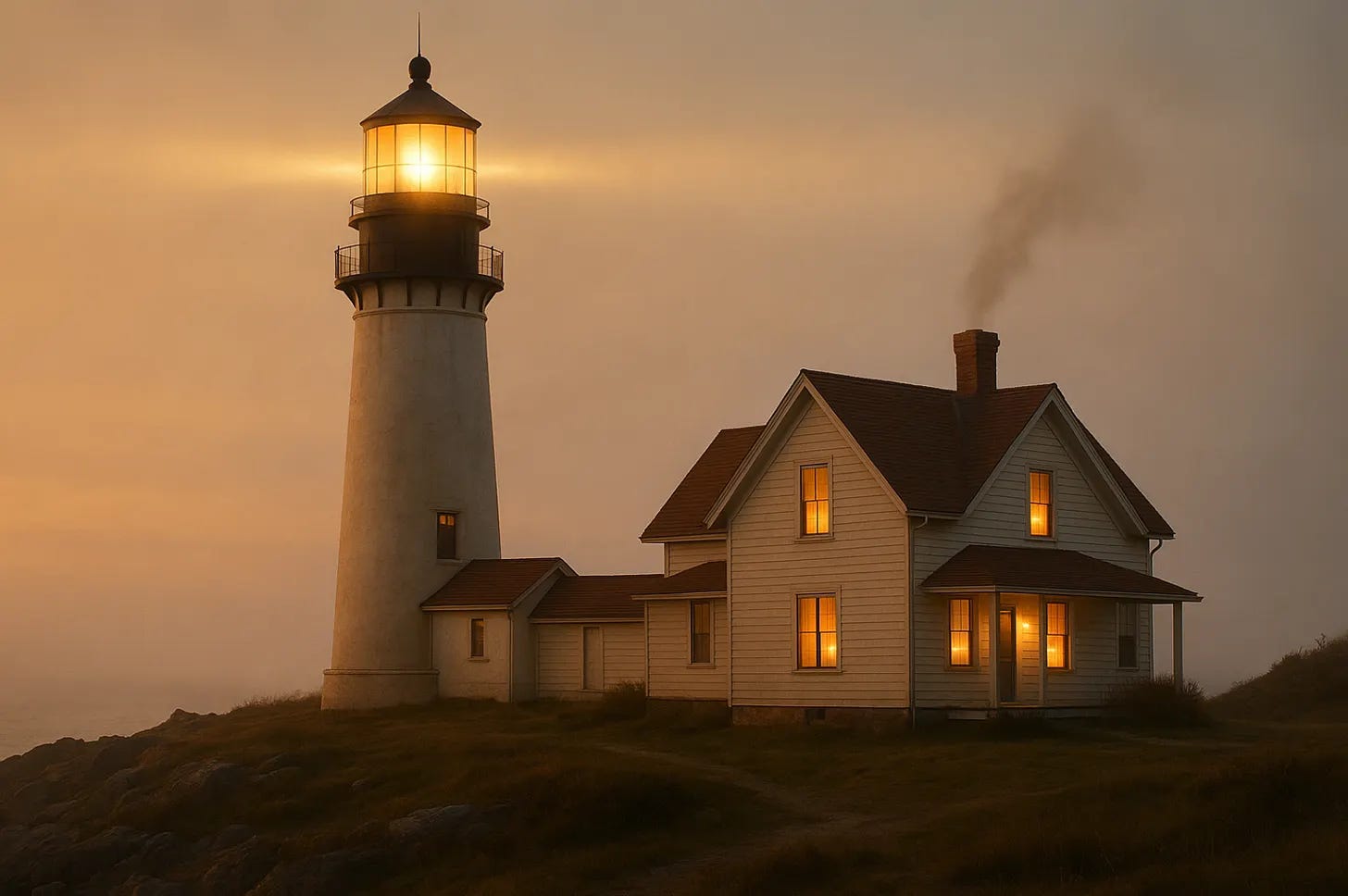
The United States has more lighthouses than any other country in the world.
Before automation, each lighthouse came with an adjacent keeper’s cottage.
That wasn’t generosity.
It was infrastructure.
The people responsible for keeping ships off the rocks couldn’t punch a time clock at five o’clock and drive home. Storms didn’t respect business hours. Fog didn’t wait for the morning shift. The keeper lived beside the light because the light depended upon constant watchfulness.
We understood this intuitively at sea.
We’ve somehow forgotten it in health care.
Today, every family caring for someone with advanced dementia, ALS, autism, heart failure, or metastatic cancer has become the modern equivalent of a lighthouse keeper. We count on them to tend the light. We just forgot to build the keeper’s cottage.
Patients undergoing recurring treatments—chemotherapy or radiation for cancer, dialysis for end-stage renal disease, infusions for gastrointestinal or autoimmune disorders, or plasmapheresis for conditions like myasthenia gravis—are often unable to drive themselves.
For their caretakers, it’s rarely practical to drop the patient off and return later. They stay. And for those holding jobs, the regularity of these medical disruptions can become overwhelming.
The financial burden falls hardest on hourly workers, who must be physically present to earn their pay. Many lack both the flexibility and the remote options to manage their dual responsibilities. Attending appointments often means losing income.
Access has become table stakes. Extended hours allow patients and caretakers to schedule around work rather than sacrifice it.
Health systems can offer something standalone competitors can’t: one day, one stop, multiple services.
We’ve made waiting rooms more comfortable, but for recurring, day-long visits, caretaker productivity matters more than comfort. The shift toward hybrid and remote work has caretakers arriving with laptops in hand. For them, we can offer something even more valuable: a place to work.
Imagine infusion centers with what feel less like waiting areas and more like airline lounges—quiet, equipped, connected. The airlines learned long ago that their best customers were the ones who traveled often. Chronically ill patients are health care’s equivalent.
Almost every chronically ill patient comes with a caretaker.
Most of them are doing two jobs at once, racing between the shore and the lighthouse.
It’s time we built the keeper’s cottage.